
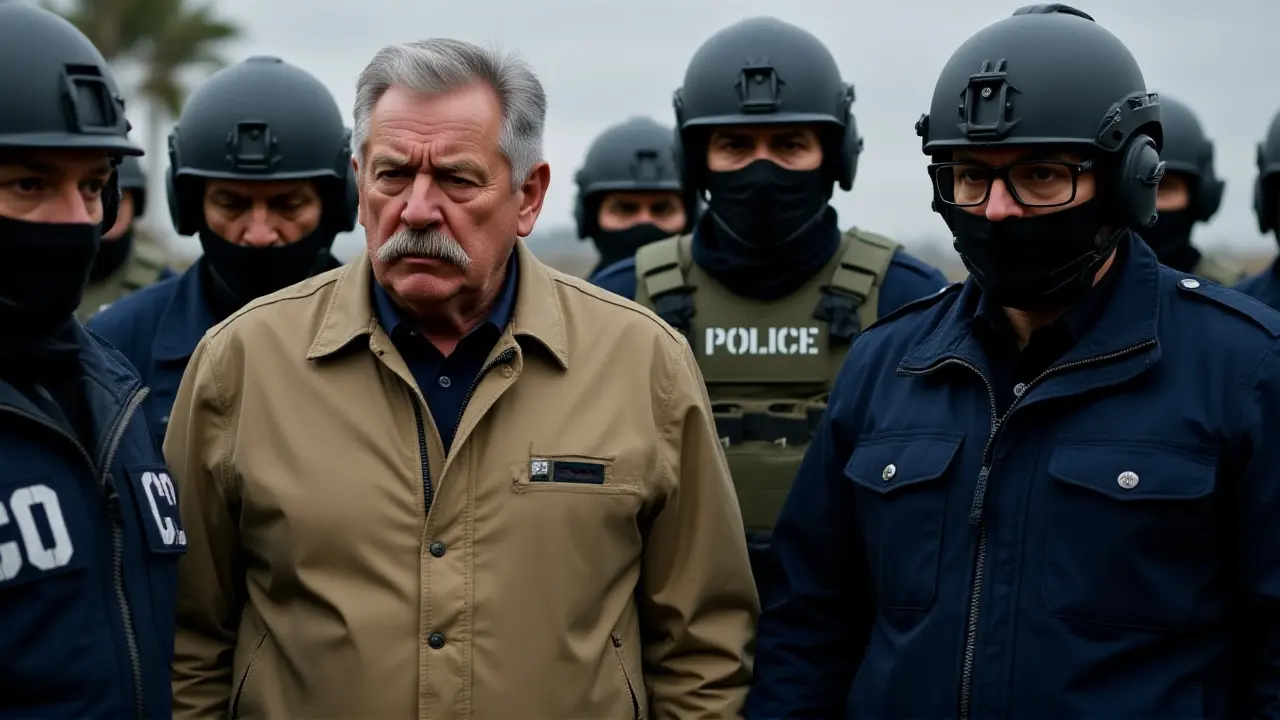
A high-ranking U.S. Army Special Forces soldier is facing a mountain of federal charges after allegedly treating classified military intelligence like a winning lottery ticket. Gannon Ken Van Dyke, a 38-year-old Master Sergeant, was arrested for using top-secret details about a mission to capture the Venezuelan leader to score a massive payday on a prediction market. The charges were unsealed in a Manhattan federal court on Thursday, April 24, 2026.
Here's the thing: this wasn't just a lucky guess. Van Dyke, based out of Fayetteville, North Carolina, allegedly leveraged his role as a communications specialist to get an inside track on one of the most sensitive operations of the year. By betting on the inevitable, he turned a modest investment into a windfall of over $400,000.
Turns out, the digital trail he left behind was far more permanent than he thought. Federal authorities say the soldier's movements on the blockchain and the timing of his trades aligned perfectly with the operational timeline of the mission to remove Nicolás Maduro from power.
The Digital Paper Trail and the $400,000 Payday
The scheme allegedly kicked off in late 2025. According to the indictment, Van Dyke created an account on Polymarket, a decentralized prediction market, on December 26, 2025. On that same day, the Commodity Futures Trading Commission (CFTC) claims he moved roughly $35,000 from his personal bank account into a cryptocurrency exchange to fuel his bets.
Between December 27, 2025, and January 2, 2026, Van Dyke didn't just bet once. He placed 13 separate trades on contracts related to Maduro and Venezuela, purchasing about $33,934 in "yes" shares. He was essentially betting on the success of an operation he was helping to coordinate (or at least communicate).
The timing was surgical. On January 3, 2026, Donald Trump announced the successful operation to capture the Venezuelan president. As the news broke, the value of those "yes" shares skyrocketed. Van Dyke allegedly sold his positions that same day, liquidated the profits, and funneled the money through a foreign cryptocurrency vault and into a brokerage account.
Key Facts of the Case:
- Total Profit: Over $400,000
- Initial Investment: Approximately $33,934 in "yes" shares
- Trading Window: Dec 27, 2025, to Jan 2, 2026
- Number of Trades: 13 specific contracts
Attempts to Cover the Tracks
Oddly enough, after making a small fortune, Van Dyke seemingly panicked. The indictment describes a series of frantic attempts to erase his digital footprint. He reportedly asked Polymarket to delete his account entirely and changed the email address associated with his crypto exchange to one that wasn't in his name. Like this. Simple, but ineffective against federal investigators.
The red flags first popped up on the platform itself. Prediction markets are often volatile, but a single user netting $400,000 on a highly specific geopolitical event triggered alarms. This led investigators to connect the dots between the trading patterns and the personnel involved in the Joint Special Operations Command (JSOC) task force.
Legal Fallout and Expert Reactions
The legal hammer coming down on Van Dyke is heavy. He's been charged with wire fraud, commodities fraud, theft of nonpublic government information, and making unlawful monetary transactions. If convicted, he's looking at potentially decades in federal prison.
Jay Clayton, the U.S. Attorney for the Southern District of New York, didn't mince words. He characterized the act as "clear insider trading," reminding the public that prediction markets aren't a "haven" for those looking to monetize classified government secrets. It's a stark warning to anyone in the intelligence community who thinks the anonymity of crypto provides a shield.
Legal analysts suggest this case is a landmark because it bridges the gap between traditional insider trading (usually associated with stocks) and the new world of prediction markets. By treating a geopolitical event as a "commodity," the government is signaling that the same rules apply whether you're trading Apple stock or the capture of a foreign head of state.
The Bigger Picture: Politics and Prediction Markets
There's a wider, more awkward context here. While Van Dyke was allegedly gambling on the outcome of a state operation, the political ties to these platforms have grown. It's worth noting that Donald Trump Jr. signed on as an adviser to both Polymarket and Kalshi last year. While there's no evidence that this advisory role played a part in the soldier's crimes, it highlights the cozy relationship between the current administration's inner circle and the very platforms used to gamble on government actions.
The fallout from this case likely means tighter scrutiny for military personnel regarding their use of financial apps and crypto wallets. The military already has strict rules about "insider trading" with government contracts, but this is a new frontier. Who knew the Special Forces' biggest enemy would be a blockchain audit?
Frequently Asked Questions
What is Polymarket and how does it work?
Polymarket is a decentralized prediction market where users bet on the outcome of real-world events. Instead of traditional betting, users buy "shares" in a "Yes" or "No" outcome; if the event happens, the shares pay out, and if not, they become worthless. In this case, Van Dyke bet on the "Yes" outcome for the capture of Nicolás Maduro.
Why is this considered insider trading?
Insider trading occurs when someone uses non-public, material information to make a financial gain. Because Van Dyke had access to classified military plans for the operation, he possessed information that the general public did not, giving him an unfair and illegal advantage in the prediction market.
What specific charges is Gannon Ken Van Dyke facing?
Van Dyke is charged with several federal crimes, including wire fraud, commodities fraud, the theft of nonpublic government information, and the unlawful use of confidential government information for personal gain. These charges are designed to cover both the theft of the secrets and the financial manipulation used to profit from them.
How did federal authorities find him if he used crypto?
While cryptocurrency provides some anonymity, the "on-ramps" and "off-ramps" (where money moves from a bank account to an exchange) are heavily monitored. The CFTC found that Van Dyke moved $35,000 from a personal bank account into his exchange, and the timing of his trades perfectly mirrored the secret military timeline, providing enough probable cause for an indictment.





The epistemological rupture here is fascinating. We are seeing the convergence of asymmetric information and decentralized oracle mechanisms, where the blockchain serves as an immutable ledger of cognitive dissonance. By attempting to arbitrage classified state secrets through a prediction market, this operative essentially performed a live stress test on the opacity of pseudo-anonymous financial rails. The systemic risk isn't just the leak, but the signal-to-noise ratio being skewed by actors with privileged access to the causality of geopolitical events. It's a textbook case of regulatory lag meeting algorithmic transparency.
Absolutey hilarius that he thought a crypto wallet would hide him from the feds lol. Imagine thinkng you're smarter than the NSA because you use a 'desentralized' app. Guy is a joke
This is such a classic example of an 'off-ramp' failure 📉. Most people think crypto is invisible, but the moment you touch a bank account to move that $35k, you've basically handed the government a map to your front door 🏠. For anyone wondering, KYC (Know Your Customer) laws are why this happened. You can't just teleport money from a regulated bank to a random wallet without leaving a fingerprint 🔍💰.
wow a soldier got greedy and got caught imagine being suprised by this basically just a government employee trying to make some real money for once
Wait, so the government actually used the blockchain to track him down? 😲 That's the irony of the century! He used the tool of the 'revolution' to commit a crime, and that same tool became the evidence for his downfall. It makes me wonder if there are other 'insiders' doing the same thing right now, just hoping they aren't the ones who trigger the alarm. This is some deep-state soap opera stuff right here!
Oh honey, imagine thinking a change of email address is a foolproof security plan in 2026. Truly an inspiration to us all in the 'how to get arrested' department 🙄.
Crypto anonymity is a myth.
UM, can we talk about the part where Trump Jr. is an adviser to these platforms?! This is the real tea! ☕️ Like, how can they be 'decentralized' when the people running the country are basically in the boardroom? It's totally suspicious and frankly, I'm shocked it didn't happen sooner. The drama of it all is just too much!
It's really sad to see someone throw away a distinguished career like this 😔. The pressure of high-stakes operations can lead people to make impulsive decisions, but the legal ramifications here are just devastating. We should hope for a fair trial and a path toward rehabilitation, regardless of the severity of the breach 🕊️. Let's remember that everyone makes mistakes when they're feeling desperate or greedy.
The legal precedent here is the most important part. By classifying a geopolitical event as a commodity, the CFTC is expanding its jurisdiction significantly. This will likely lead to a wave of new regulations targeting any platform that allows betting on political outcomes, as it creates a massive incentive for espionage and insider trading within government agencies.
Omg wake up ppl!! This is just a distraction from the real plot!! They probably let him do it just to justify baning all prediction markets so they can control the odds themself. Totaly fake news aarrrgh the govt just wants our crypto lol 🤡
Wow, such a crazy story! 😱 It just goes to show that honesty is always the best policy in the end. I hope others can learn from this and stay focused on their duties! Stay strong everyone! ✨
Man, imagine having a $400k win and then panicking so hard you ask the website to delete your account lol 🤣. Just a wild way to get caught! Keep grinding and keep it legal guys! 🚀🔥
I hope we can find a way to balance financial innovation with national security without taking away too many liberties 😊.
this is a tough lesson for the soldier but necessary for the system to work
it is regrettable that such a professional fell to temptation i believe the system will rectify this
He clearly stepped over a line that should never be crossed in our profession.
Just another day in the modern age I guess. Everything is tracked, nothing is secret, and greed always wins until the handcuffs click.